Battery storage in Poland: where you can still connect a BESS
Battery storage projects in Poland hold connection conditions for more than 34 GW, but few places on the grid can take a battery in both directions: none of 415 PGE, Enea, TAURON and Energa grid areas has 100 MW free for both generation and load, and only three have 50 MW. We put together the operators’ data on free generation and load capacity, the rule changes from 16 October 2026, and a list of what to check before you lease land.
EnergyPublished10 min read
The Polish BESS market in numbers
On paper Poland has tens of gigawatts of battery storage. These are connection statuses, though, not working installations, and many of the projects will never be built. PSE’s aggregated register for the transmission grid and the five largest distribution operators gives these figures for energy storage (discharge capacity and charge capacity):
- Connection conditions issued: 34.5 GW and 36.2 GW.
- Connection agreements in force: 21.1 GW and 20.6 GW.
- Complete applications under review: 7.9 GW and 8.3 GW.
- Conditions refused: 2.4 GW and 2.2 GW.
- Connected: 0.1 GW and 0.1 GW.
The data comes from table 1 of PSE’s aggregated connection register (in Polish): the transmission grid as of 31 August 2026, and the Energa, Enea, PGE, TAURON and Stoen grids as of 30 June 2026.
The largest projects under construction are Greenvolt’s battery in Siedlce (600 MW, 2,400 MWh, due to start at the end of 2027) and PGE’s battery at Żarnowiec (262 MW, about 981 MWh, second quarter of 2027, Ministry of Energy, in Polish). Six of the seven large projects described by UmowaPPA (in Polish) are financed on a capacity market contract.
The grid connection barrier
In 2025 operators issued fewer connection refusals than a year earlier (4,897 against 7,817), but the capacity refused grew from 73.6 GW to 107 GW. The projects being turned down are getting bigger. Mazowieckie had the most refusals (URE report as summarised by Gramwzielone.pl, in Polish).
The queue is being cleaned up by the act of 13 March 2026 amending the Energy Law (Journal of Laws 2026 item 516, in Polish), known in the industry as the UC84 package. These are the changes that matter most for storage:
- Conditions valid for one year. Conditions for the electricity grid issued from 30 April 2026 are valid for one year from delivery, not two (Article 7(8i) of the Energy Law). There is less time to sign a connection agreement.
- An advance of 60 zł/kW. An application to connect to the grid above 1 kV comes with 60 zł for every kW in the application, up to 6 million zł (Article 7(8a) and (8b)). It does not apply when adding an installation or a battery to an existing connection point. An application filed just in case now costs real money.
- Security after the agreement. On top of the advance: 30 zł/kW up to 100 MW and 60 zł/kW above that, up to 12 million zł. It has to be lodged within 14 days of signing the agreement, or the agreement expires by law (Article 7(8c1) and (8c9)).
- Cable pooling. Two or more installations or batteries can be connected at one connection point above 1 kV (Article 7(1f)). A battery can be added to the connection of a solar or wind farm, but the operator still has to issue conditions for it.
- Building law. Since 7 January 2026, a battery outside a building needs no formalities up to 30 kWh. From 30 to 2,000 kWh it needs a notification with documentation agreed for fire safety (from 300 kWh also notice to the fire service), and above 2,000 kWh a building permit. Inside a building a permit is needed above 300 kWh (act of 4 December 2025, Journal of Laws 2025 item 1847, in Polish). A grid-scale battery therefore needs a building permit.
What a specific project needs depends on its parameters, and this list is not a substitute for legal advice.
What changes on 16 October 2026
On that day the act’s transitional provisions take effect (Articles 9, 11, 13 and 14). They cover projects that received conditions or signed an agreement before 30 April 2026:
- The advance has to be topped up. Anyone who received connection conditions before 30 April 2026 that remain valid for at least six more months, but has not signed an agreement, pays or tops up the advance to 60 zł/kW, at most 6 million zł per connection, by 30 October 2026 (PSE notice). Otherwise the conditions lapse (Article 9).
- Security of one quarter. Once such a developer signs the agreement, it lodges security of one quarter of the amount under the new rules (Article 11).
- Security for distant connection dates. Anyone who signed an agreement before 30 April 2026 with a connection date later than 30 April 2029 lodges security of one quarter of the amount under the new rules, also by 30 October 2026. Advance payments made under the agreement count towards it. Without the security the agreement expires by law (Article 11).
- Agreements lapse without a building permit. Agreements to connect to the grid above 1 kV signed in the 48 months before 30 April 2026 expire by law if the developer does not notify the operator of a final building permit. For battery storage the deadline is 30 months from 30 April 2026, and the permit has to cover at least 80% of the power and 80% of the capacity in the agreement (Article 13). Older agreements fall under Article 14.
This does not mean a pool of free capacity appears on 16 October. Expired conditions for one project do not mean the same node will accept the next. Operators will update their disclosures (PSE monthly, distribution operators quarterly), so it is worth following the nodes you are interested in.
Where there is free capacity in both directions
A battery needs capacity both ways: to export power, like a generator, and to draw it, like a consumer. Operators publish the two figures separately, so we paired them for every PGE, Enea and TAURON grid area and every Energa high-voltage zone. We took the lower of the two as the capacity available in both directions.
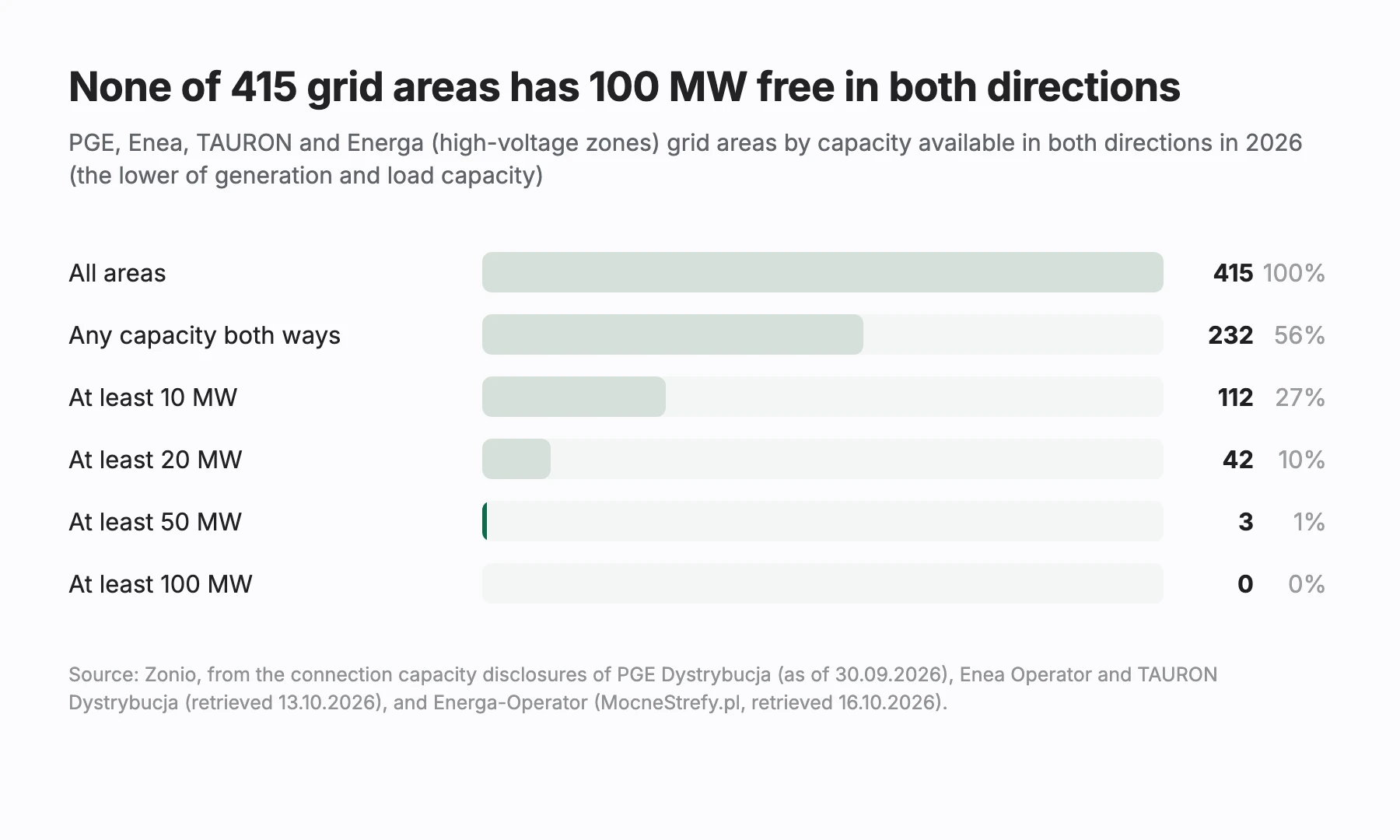
The transmission grid is tighter still. PSE shows 0 MW available for new generation at every 220 and 400 kV node, both today and in its 2031 forecast (PSE, as of 30 September 2026, in Polish). That does not rule out connecting a battery to the distribution grid, but it shows how little room is left on the transmission grid. How to read these figures is explained in our article on connection capacity.
These areas currently have the most capacity in both directions (generation and load capacity, with the both-ways figure in brackets):
- Biłgoraj (PGE, Podkarpackie and Lubelskie): 90 and 65 MW (65 MW).
- Towarowa (Enea, Poznań): 58 and 57 MW (57 MW).
- Wieruszów (Energa, Łódzkie, Wielkopolskie, Opolskie and Dolnośląskie): 105 and 50 MW (50 MW).
- Żelechowo (Enea, Szczecin): 44 and 54 MW (44 MW).
- Adamowo (PGE, Podlaskie): 40 and 75 MW (40 MW).
- Ostrów (Energa, Wielkopolskie, Łódzkie and Dolnośląskie): 105 and 40 MW (40 MW).
- Turzyn (Enea, Szczecin): 63 and 39 MW (39 MW).
- Tarnobrzeg (PGE, Podkarpackie and Świętokrzyskie): 190 and 35 MW (35 MW).
- Przemyśl (PGE, Podkarpackie): 130 and 35 MW (35 MW).
- Żegrze (Enea, Poznań): 85 and 35 MW (35 MW).
Large battery projects in Poland are now 100 MW and more, and no area in these four operators’ disclosures shows that much in both directions. For smaller batteries on the medium-voltage grid, the 112 areas with at least 10 MW are the more useful number.
Contrary to what you might expect, generation capacity runs out more often than load capacity: 306 areas have at least 10 MW for load, but only 168 for generation. In 270 of the 415 areas generation capacity is lower than load capacity, and in 121 it is the other way round. The reverse happens too: Tarnobrzeg and Przemyśl have 130 to 190 MW for generation, but only 35 MW to charge a battery. Stoen Operator publishes its data in different zones, so it is not in this comparison. Energa gives generation capacity only for its high-voltage zones, so its medium-voltage zones, which have load capacity only, are left out too.
This is a list of areas worth a closer look, not a connection promise. Whether a particular battery gets conditions depends on the operator’s analysis for a specific point on the grid, which is not always the nearest GPZ substation.
How much free capacity there will be in later years
Operators publish not only free capacity for 2026, but also its planned changes over the next five years (Article 7(8l)(2) of the Energy Law). A forecast in both directions can be put together for PGE and Energa, because they publish one for both generation and load. Enea forecasts generation only, and TAURON publishes current figures only.
For these two operators (92 areas: 47 PGE substation groups and 45 Energa high-voltage zones), capacity in both directions over the coming years looks like this:
- 2026: 32 areas have at least 10 MW, two have 50 MW (Biłgoraj and Wieruszów), and none has 100 MW.
- 2027: almost no change. 33 areas have at least 10 MW, still two have 50 MW, and none has 100 MW. The biggest gain is PGE’s Kielce group, from 25 to 40 MW in both directions.
- 2030: 61 areas have at least 10 MW, 36 have 50 MW, and 18 have 100 MW: 16 Energa zones plus Łęczna (160 MW) and Zamość (125 MW) at PGE. The highest figures are in Energa’s Płock and Kalisz Północ zones (165 MW each), Ostrów (145 MW), Adamów (140 MW) and Konin (135 MW).
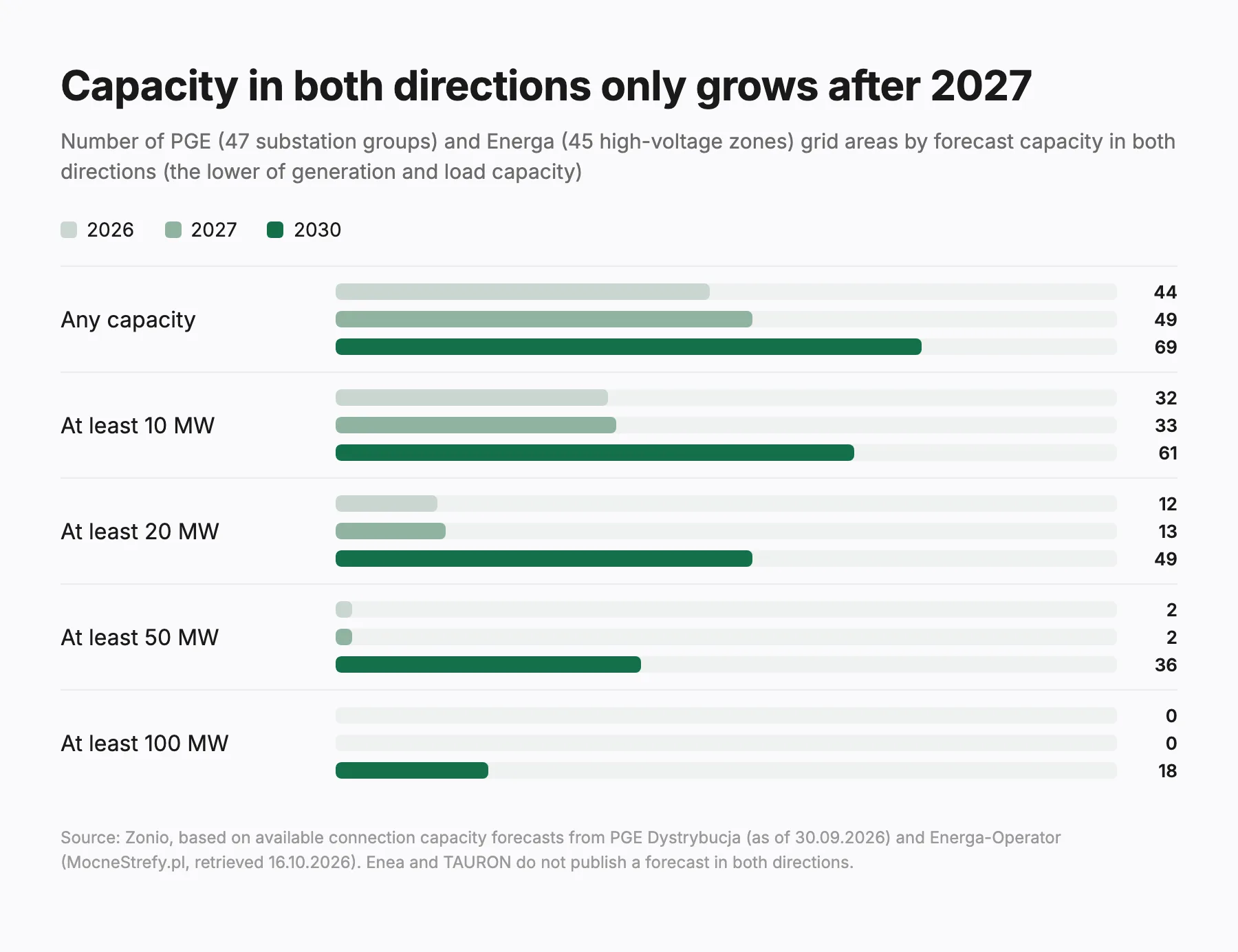
So the new capacity arrives between 2028 and 2030, not in 2027. Energa peaks in 2030: by 2031 only 7 of its zones have 100 MW.
These are the operators’ plans, not commitments. They depend on grid investments being finished on time, and they change as the operator issues conditions to other projects, which is why Energa’s figures fall in 2031. For a battery due to start in 2029 or later, though, the forecast for that year matters more than the 2026 figure.
BESS site checklist
Before you sign a lease, check the plot in this order: from what kills a project to what only adds cost.
1. Capacity both ways. Free generation and load capacity in the grid area that actually serves the plot. The lower of the two is what counts.
2. Connection point and distance. The right point depends on the grid layout, not only on distance. Every kilometre of medium- or high-voltage line adds cost and needs consent to cross other people’s land.
3. Land use. Check what the zoning plan allows. A symbol such as E or PU does not settle the question for a specific installation. If there is no plan, check what the Municipal General Plan provides and whether the required decisions can be obtained.
4. Nature protection. Check Natura 2000 sites, landscape parks and protected landscape areas, and whether the project will need an environmental decision. That depends on its parameters.
5. Flood hazard. A battery container in a flood hazard area is a problem for the insurer and the bank.
6. Soil class. Class I to III farmland means an extra procedure to take the land out of agricultural use.
7. Neighbours. Check the distance to homes. Noise from cooling systems and inverters, and fire safety, are common reasons for local protests.
8. Access. A road that can carry the containers and the transformer, and access for the fire service.
The first three points rule out many sites before you even talk to the landowner. If a plot passes all eight, consider a conditional lease that depends on obtaining connection conditions and permits.
How to check this in Zonio
In Zonio the connection capacity of all six operators sits on one map with your plot, together with the zoning plan, the Municipal General Plan, nature protection, flood hazard and soil class. Each GPZ and each zone shows generation and load capacity separately, so you can check capacity in both directions without opening several operators’ disclosures. Where the operator publishes a forecast, the GPZ or zone also shows capacity for later years.
Zonio does not replace the operator: only the connection conditions issued on your application give a binding answer.
Methodology
The chart and the list of areas come from the public connection capacity disclosures that operators publish under Article 7(8l) of the Energy Law (all in Polish):
- PGE Dystrybucja: total available connection capacity, 47 groups of 110 kV substations, as of 30 September 2026.
- Enea Operator: connected and available renewables capacity, 248 GPZ 110 kV substations, retrieved 13 October 2026.
- TAURON Dystrybucja: capacity map, 75 grid areas, retrieved 13 October 2026.
- PSE: available connection capacity, 220 and 400 kV nodes, as of 30 September 2026.
- Energa-Operator: MocneStrefy.pl, 45 high-voltage zones with generation and load capacity, updated 25 September 2026, retrieved 16 October 2026. Each zone has separate generation and load figures under the same number.
From each disclosure we took two 2026 figures, generation capacity and load capacity, and paired them for the same grid area. That gives 415 areas. Capacity in both directions is the lower of the two, because a battery that charges and discharges at full power is limited by the weaker direction. It is a screening indicator, not guaranteed capacity. The forecast for 2027 to 2031 is calculated the same way, from the figures PGE and Energa give for each year.
Limitations: a PGE area (a group of several substations) and an Energa high-voltage zone (usually several counties) are not comparable with a single Enea GPZ, and a group’s figure is shared by all its substations and does not add up. The disclosures do not reflect pending applications or the effect of the transitional provisions, and they change with every update.
Frequently asked questions
How much battery storage in Poland has connection conditions? According to PSE’s register, storage holds conditions for 34.5 GW of discharge capacity and 36.2 GW of charge capacity (transmission grid as of 31 August 2026, distribution grids as of 30 June 2026).
Does a battery need a building permit? Outside a building, yes above 2,000 kWh. From 30 to 2,000 kWh a notification is enough, and up to 30 kWh there are no formalities. Inside a building a permit is needed above 300 kWh.
What changes on 16 October 2026? The transitional provisions of the UC84 act take effect. By 30 October 2026, holders of conditions from before 30 April 2026 without an agreement have to top up the advance to 60 zł/kW, and agreements with a connection date after 30 April 2029 need security. Connection agreements signed in the 48 months before 30 April 2026 will expire if the developer does not notify the operator of a final building permit in time. For battery storage that is 30 months from 30 April 2026.
Will there be more free capacity for batteries in later years? According to the operators’ plans, yes, but not everywhere. On PGE’s grid two substation groups (Łęczna and Zamość) have 100 MW in both directions from 2028, and on Energa’s grid 12 high-voltage zones do in 2029, although none does in 2026. These are forecasts that depend on grid investments and on the conditions issued to other projects.
What does a connection application for a battery cost? The advance is 60 zł for every kW in the application, up to 6 million zł, so 600,000 zł for a 10 MW battery. After the agreement comes the security: 30 zł/kW up to 100 MW.