How to check grid connection capacity and the distance to a substation in Poland
Before you sign a land lease for a solar farm, a battery site or an industrial building, check two things: whether connection capacity is available, and how far the plot is from a suitable substation. This is where to find that information, how to read it, and how a connection application works since 30 April 2026.
EnergyPublished8 min read
Why check the grid before the lease?
For large renewable projects, energy storage and industrial consumers, the binding constraint is often not the land but the connection to the grid.
In 2025 Polish operators issued 4,897 connection refusals covering 107 GW in total (URE data reported by Gramwzielone.pl). A refusal can be technical (the local grid is already full) or economic (reinforcing the grid would not pay for the operator).
So before you pay for a design or environmental documentation, check whether the site has a realistic chance of a connection.
1. Check the voltage level and the kind of capacity
The Polish grid has four basic voltage levels: nN (up to 1 kV), SN (usually 15 or 20 kV), WN (mainly 110 kV) and NN (220 and 400 kV).
The transmission grid is run by PSE, and the distribution grid by operators such as PGE Dystrybucja, Enea Operator, Energa-Operator, TAURON Dystrybucja and Stoen Operator.
Solar farms from a few dozen kW to about 5 MW usually connect to the medium-voltage (SN) grid, exceptionally up to 10 MW. Larger installations tend to connect at 110 kV (UDE technical note, in Polish). What matters then is the 110 kV to medium-voltage substations, called GPZ (główny punkt zasilający). It is the operator, though, who decides which voltage level and connection point suit a given project.
Generation and load capacity are two different numbers. A solar farm needs capacity for generation, the ability to feed power into the grid. A warehouse or a data centre needs load capacity, the ability to draw power. A battery does both, so you check both. The same substation can have plenty of one and none of the other.
2. Where to check available connection capacity
Operators publish the connection capacity available, planned changes over the next five years, and the applications and agreements for connections to the grid above 1 kV. The obligation comes from Article 7(8l) of the Polish Energy Law, and the data is updated quarterly (URE notice, in Polish).
Each operator publishes on its own site, in its own format. Enea runs a capacity map and a separate renewables capacity list. The others publish on their connection pages, for example TAURON Dystrybucja and PGE Dystrybucja. For the transmission grid, see what PSE publishes. All of these are in Polish.
To find the right figures, first work out which operator covers the plot. Then look up the substations in your area and compare their figures with the planned size of the installation.
Keep in mind: published capacity is not a connection promise. It is the position on the day of publication, and other developers file applications in the meantime. Whether you can connect depends on the operator's own analysis and the connection conditions it issues. It is also worth checking planned grid investments and whether you could share a connection with another installation (cable pooling).
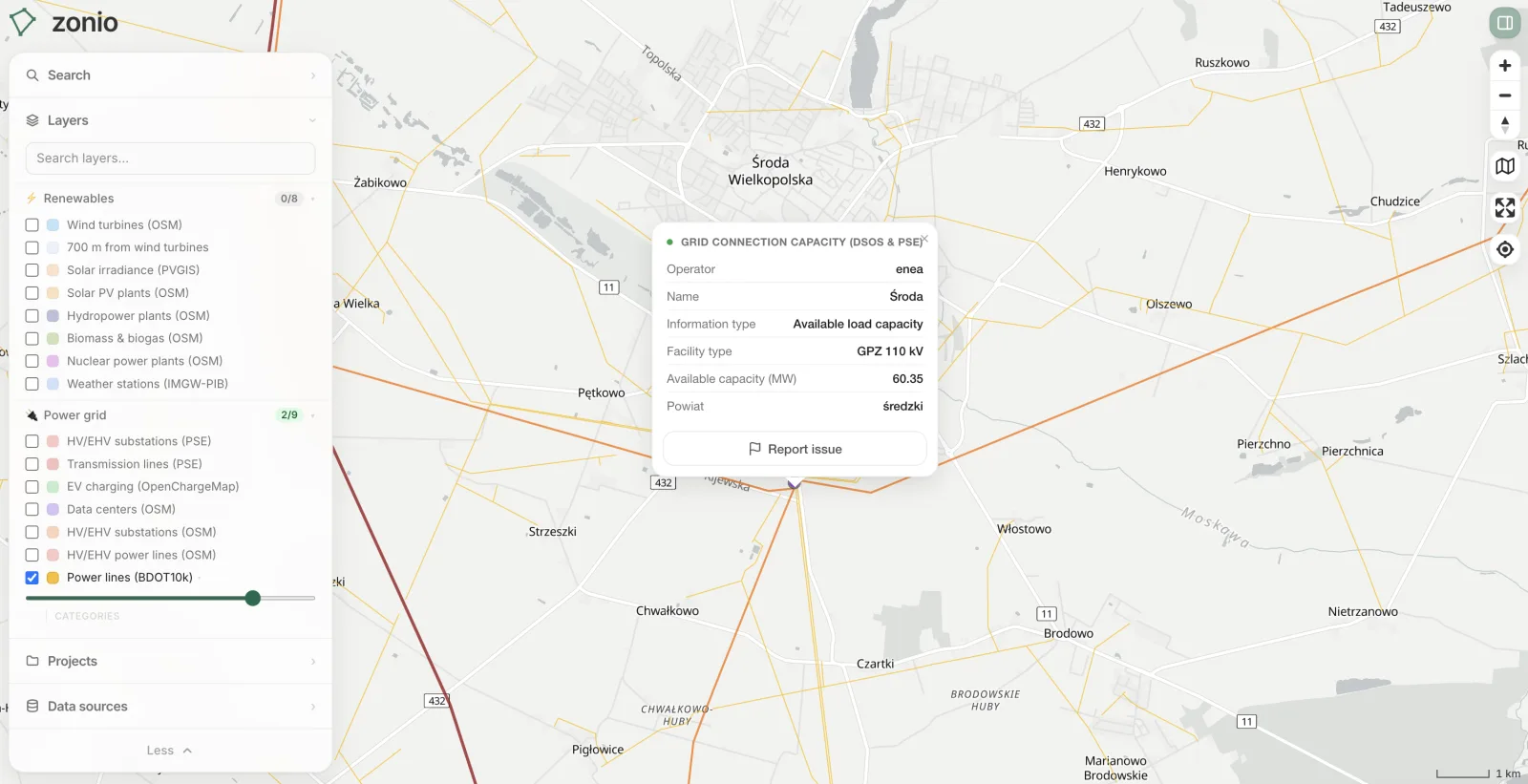
3. How to check the distance to a substation
You can make a first check of where the infrastructure is on maps.
PSE: extra-high-voltage substations and transmission infrastructure.
OpenStreetMap: many substations and part of the high and extra-high voltage lines.
BDOT10k: GUGiK's topographic data, including power lines, medium voltage among them, and transformer stations.
Once you have found the plot and the substations near it, measure the distance to a possible connection point. Do not stop at a straight line: the real route of the connection can be longer because of terrain, roads, rivers and existing buildings. Every plot in between needs its owner's consent, and every extra kilometre of line adds to the connection cost.
OpenStreetMap is built by volunteers, so its data can be incomplete or out of date.
4. How a connection application works since 30 April 2026
On 30 April 2026 the amendment to the Energy Law of 13 March 2026 came into force (the so-called grid act, draft UC84). It changed the rules for connecting to the medium- and high-voltage grid (DZP summary, in Polish).
The advance payment is higher, and consumers pay it too. When you apply for a connection to the grid above 1 kV you pay an advance on the connection fee: 60 zł for every kilowatt of connection capacity in the application, up to 6 million zł per connection. It used to be 30 zł/kW and at most 3 million zł. The obligation now covers consumers too, such as warehouses and data centres. Without the full advance the application is left unconsidered (Energa-Operator notice, TAURON Dystrybucja notice, both in Polish). For a 1 MW farm the advance is 60,000 zł.
Connection conditions last less time. Conditions for the electricity grid issued from 30 April 2026 are valid for one year, not two. Conditions issued earlier keep their two years. The connection agreement has to be signed while they are valid.
The agreement has a hard deadline for the building permit. If you do not notify the operator of a final building permit within the statutory period after signing the connection agreement, the agreement expires by law.
In practice, apply only once the land, the zoning plan and the permit route are checked. Reserving capacity just in case has become expensive.
5. What to check before signing a lease
Before you commit to the land, work through this list:
1. Identify the grid operator for the plot.
2. Check the current figures for the capacity your project needs (generation, load or both).
3. Identify the nearby substations and their voltage levels.
4. Check planned grid investments.
5. Measure the approximate distance from the plot to a possible connection point and assess where the line could run.
6. Check that the Municipal General Plan and the zoning plan allow this kind of project on the land.
7. Work out the application advance and go over the results with the operator or a specialist.
It is also worth considering lease clauses that protect the developer if connection conditions cannot be obtained.
How Zonio helps
In Zonio these layers sit on one map with your plot, together with the available connection capacity published by TAURON, PGE, Energa, Enea, Stoen and PSE. Each GPZ shows its generation and load capacity, without searching six operators' sites.
Enea publishes station coordinates. PGE, Energa, Stoen and PSE publish PDF tables with station names only, so we place those stations by name and the location can be approximate. Check the figures in the operator's own publication before you apply.
Next to the grid you see what decides the rest of the project: the Municipal General Plan, the zoning plan, soil class, nature protection, flood hazard and solar irradiance. Every layer carries its source and retrieval date.
The grid layers are in the Pro plan, which covers the whole layer catalogue and unlimited reports. Zonio does not replace the operator: only the connection conditions give a binding answer.
Frequently asked questions
What is connection capacity? The power an operator can connect at a given point of the grid without reinforcing it. Operators publish it separately for generation and for load.
What does a connection application cost? For the grid above 1 kV you pay an advance of 60 zł per kW of connection capacity in the application, up to 6 million zł per connection. The advance counts towards the connection fee.
How long are connection conditions valid? Conditions for the electricity grid issued from 30 April 2026 are valid for one year. Earlier ones keep their two years.
What is a GPZ? A main supply point: the substation where the 110 kV grid steps down to medium voltage. For larger installations the nearest GPZ usually decides whether a connection is possible, and where.
Does published free capacity guarantee a connection? No. It is for guidance only. Only the connection conditions issued on your application are binding.