Planned solar and wind farms in Poland: how to check what is coming next to a plot
Before a solar or wind farm goes up next to a plot, the authorities produce several documents about it: an application for an environmental decision, the decision itself, and then a building permit. We gathered those documents into one map layer: 29,211 projects pinned to parcels, cadastral precincts or municipalities. The environmental documents come from two sources: the Ekoportal archive, which ends in June 2025, and the notices of the regional environmental directorates (RDOŚ) since January 2025, mostly about wind farms. The building permits come from the GUNB register and go up to October 2026. Here is what each stage means, what the numbers say, and how to check the area around a specific property.
EnergyPublished8 min read
Which documents come before a farm is built
A larger ground-mounted solar farm, a wind farm or a biogas plant usually starts with a decision on environmental conditions (DŚU), issued before the building permit. Whether a given installation needs one depends on how the whole project is classified. For ground-mounted solar the threshold is the area measured around the outermost panels: 0.5 ha in protected areas such as national and landscape parks, nature reserves, protected landscape areas and Natura 2000 sites, and in the buffer zones of parks and reserves, and 2 ha everywhere else. Installations on the roofs and facades of buildings do not need an environmental decision (regulation of 10 August 2023, in Polish). For biogas plants and battery storage the obligation depends on the type and scale of the installation, so not every one of them needs a DŚU.
Each stage leaves a trail of documents:
- An application for a DŚU, usually with a project information sheet and the parcel numbers.
- Opinions and approvals from the competent authorities, depending on the type and location of the project, including the regional environmental directorate (RDOŚ), the sanitary inspectorate and the water authority. If the authority decides an environmental impact assessment is needed, the investor prepares an environmental impact report.
- The outcome: an environmental decision, a refusal or a discontinuation of the proceedings. A decision can also be transferred to another investor when the project changes hands.
- The building permit, which goes into the register of the Chief Building Supervision Office (GUNB).
The building permit application has to be filed within 6 years of the day the environmental decision became final. The deadline is 10 years if, before the 6 years run out, the authority that issued the decision confirms that the project’s conditions are still current. Offshore wind farms, among others, get 10 years by law (art. 72(3), (4) and (4b) of the Act on access to environmental information, in Polish). If more than 6 years have passed since the decision and the register shows no building permit, the project may be out of date. That does not automatically mean the decision has expired: the investor may have obtained the longer deadline, and a permit may have been issued outside the data we analyse.
Where the data comes from
Public offices must keep publicly available registers of environmental documents, including applications for and decisions on environmental conditions (art. 21 and 22 of the same act). Until the end of June 2025, many of them did this in the Wykaz application on Ekoportal. Since 1 July 2025 the offices keep the registers themselves, and the data gathered before is available as a read-only archive (Ekoportal, in Polish).
From that archive we took 23,400 documents whose titles concern solar PV, wind, battery storage, biogas or hydropower. We added 24,770 building permit applications and decisions for such installations from the GUNB register, filed since 2018.
The second source of environmental documents is the notices that the 16 regional environmental directorates publish on their BIP pages on gov.pl. We collect the ones about wind and solar farms published since 1 January 2025. By 1 November 2026 there were 988 of them, 947 about wind. There are few notices about solar farms, because most of their environmental decisions are issued by the municipality: over 12 months we found 2 solar farms on the RDOŚ pages, against about 190 wind cases.
The 988 notices concern 271 cases. 203 of them are on the map: 76 continue a project from the Ekoportal archive, recognised by the same case number, 125 are new projects, and 2 joined a building permit from GUNB. For the other 68 we could not read the municipality, usually because the notice is a scan with no text layer.
We join the documents of one case into one project by the office’s case number, and a building permit to an environmental decision by a shared parcel. The location comes from the parcel and precinct numbers in the document title, and for RDOŚ notices from the PDF attached to them.
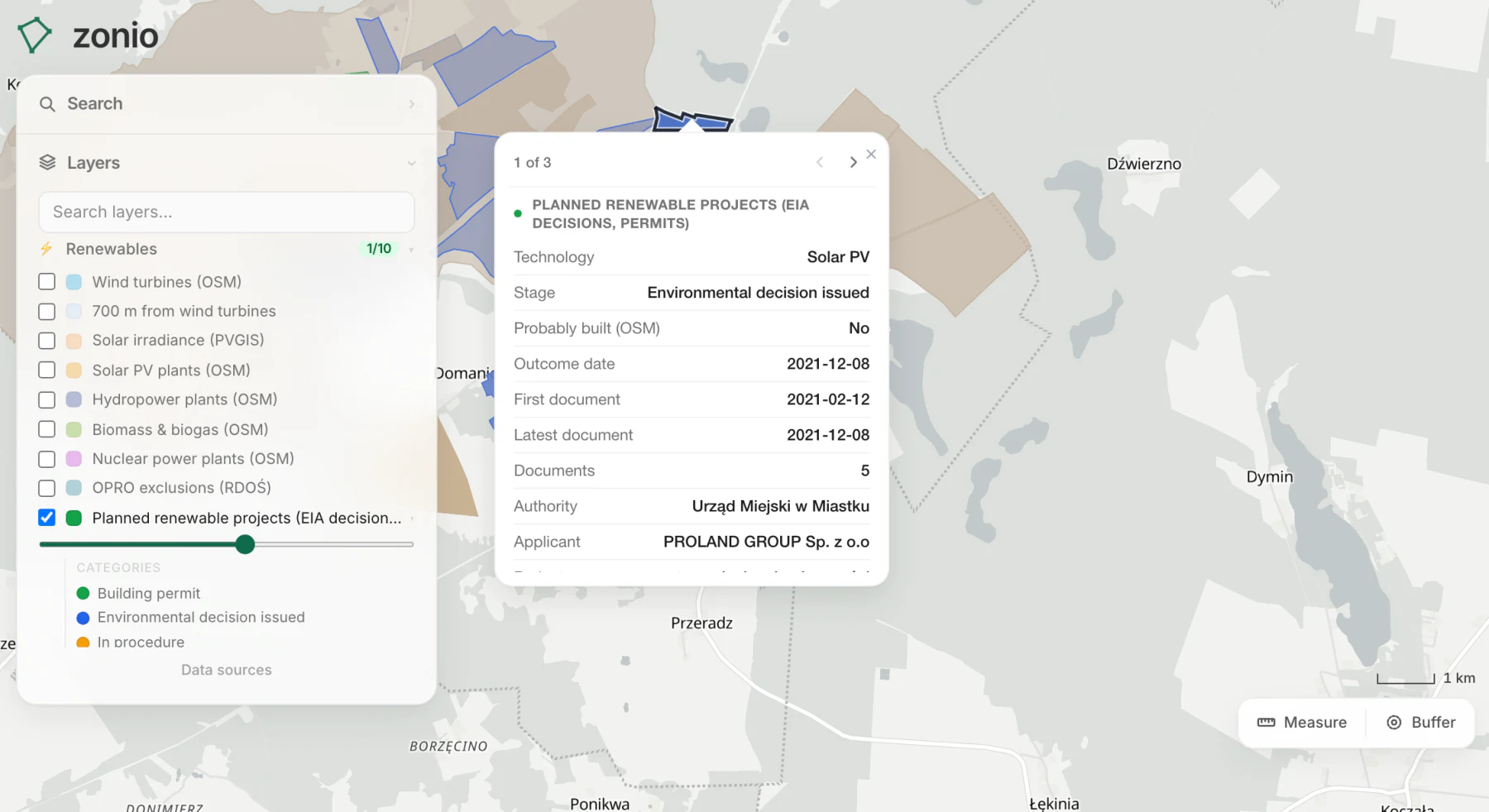
What the colours mean
- Building permit (green): the GUNB register holds a permit for the parcel. Some of these installations are already built.
- Environmental decision issued (blue): there is an environmental decision less than 6 years old, but no permit yet.
- In procedure (amber): there is an application or documents from the proceedings, but no outcome yet.
- Environmental decision over 6 years old (grey): the decision is more than 6 years old and we found no permit. The project may be out of date, but the decision has not necessarily expired: the deadline may have been extended to 10 years, and a permit may have been issued before 2018.
- Discontinued / refused (red): the latest outcome is a discontinuation of the proceedings or a refusal.
- No outcome (beige): the newest document is more than 3 years old, and none of them is a decision. Often these are cases whose later steps never reached the register.
The shape shows how precisely we know the location. Filled parcels mean the parcel numbers in the document match the land register. A faint outline of a whole precinct appears when we only know the precinct, and a point in the municipality when we only know which municipality the project concerns. The “Probably built (OSM)” field says whether OpenStreetMap already shows a power plant of the same kind on those parcels.
What the numbers show
The detailed numbers below come from the data before the RDOŚ notices were added: they cover environmental documents from Ekoportal up to 30 June 2025 and building permits up to 28 October 2026. At that point the layer held 28,791 projects. 2,580 of them are panels on buildings, carports and halls, which we hide on the map because they are not farms. Of the remaining 26,211:
- 19,296 are solar PV, 4,706 wind, 1,088 biogas, 607 battery storage and 514 hydropower.
- 15,277 have a building permit, 1,392 an environmental decision without a permit, and 742 are in procedure.
- 1,955 have a decision older than 6 years with no permit, 325 proceedings were discontinued or refused, and 6,520 have had no outcome for more than 3 years.
- For 2,622 projects, OpenStreetMap already shows an installation of the same kind.
With the RDOŚ notices added, the layer holds 29,211 projects, of which 26,631 are shown on the map.
Projects still under way, meaning with an environmental decision but no permit or still in procedure, are most numerous in the Kujawsko-Pomorskie (374), Wielkopolskie (263), Pomorskie (256), Lubuskie (178) and Warmińsko-Mazurskie (173) voivodeships, and least numerous in Małopolskie (37) and Podlaskie (31). These shares also depend on how many offices in a region published their documents on Ekoportal, so they are not a full picture of the market.
Solar replaced wind
The number of environmental decisions in the archive shows how the law changed. Wind had the most in 2009 and 2010 (142 and 144 a year). In July 2016 the Act on wind farm investments introduced the 10H rule: a turbine must stand at least ten times its total height away from a residential or mixed-use building (Act of 20 May 2016, in Polish). In 2018 and 2019 there were only 7 and 5 decisions for wind.
Solar went the other way: from 105 decisions in 2018 to 285 in 2019 and 365 in 2021. In 2022–2024 there were between 318 and 361 a year.
A wind turbine can only be sited on the basis of a local zoning plan. Since 23 April 2023 the plan can set a distance from a residential or mixed-use building shorter than 10H, but no less than 700 m. The rule also works the other way: a new residential or mixed-use building must, as a rule, stand at least 700 m from a wind turbine (art. 3 and 4 of the Act on wind farm investments, in Polish). This does not apply to turbines whose building permit became final before 23 April 2023 (art. 12 of the Act of 9 March 2023, in Polish). The 700 m zone around existing turbines has its own layer, but around older turbines the restriction on new housing does not apply. The archive, which ends in mid-2025, does not yet show wind coming back: in 2024 there were 23 decisions for wind and 318 for solar.
Newer wind cases show up in the RDOŚ notices: since January 2025, 947 of them concerned wind, and 327 wind projects on the map have a document from after 1 July 2025. Before this source was added, there was not a single one.
How to check the area around a plot
1. Turn the layer on. In the Renewables group, tick Planned renewable projects and zoom in to the plot.
2. Click a project. The window shows the technology, the stage, the capacity from the document, the authority, the applicant and the dates. The “Source document” link opens the document’s card on Ekoportal, the notice on the RDOŚ page, or the GUNB search for permits.
3. Measure the distance. The Measure tool shows how far a project is from the plot boundary, and Buffer draws a zone of the radius you choose.
4. Read the document. The map shows that a project was planned. The details, such as the extent of the investment, the height of the turbines or the conditions in the decision, are in the document itself. Cases run by municipalities after June 2025, including most solar farms, are only in the register and the notices on the office’s BIP.
5. Combine it with other layers. Next to the planned projects, check the local zoning plan, the areas excluded from OPRO and the building permits nearby.
Limits of the data
The Ekoportal archive ends on 30 June 2025, and not every office used it. The RDOŚ notices fill in later cases, but almost only wind ones. Environmental decisions issued by municipalities after June 2025, including those for most solar farms, are published only on the municipality’s BIP and are not on the map. A project missing from the map therefore does not mean nothing is planned nearby.
The location comes from the documents. Of the 26,211 projects, we pinned 17,001 to parcels, 2,134 to a precinct and 7,076 only to a municipality. Some documents in the archive name no area, and if the title does not name one either, the project is not on the map. Some RDOŚ notices are scans we cannot read parcels from, so those projects are placed in the municipality named in the title.
The capacity comes from the document title and is sometimes written there wrongly, for example in kW instead of MW. We correct obvious mistakes, but treat it as indicative.
We cover building permits from the GUNB register since 2018. The stage is set from the documents in the data, so a project may have had a permit issued earlier or outside these sources. Data as of: the Ekoportal archive up to 30 June 2025, RDOŚ notices from 1 January 2025 to 1 November 2026, the GUNB register with documents up to 28 October 2026.
Frequently asked questions
How do I check whether a solar farm will be built next to my plot? Turn on the planned renewable projects layer on the map, then check the register of environmental documents and the notices on the municipality’s BIP, where new applications and environmental decisions are published. Building permits are in the GUNB search.
Does a solar farm need an environmental decision? On the ground, yes, if the panels cover at least 2 ha, or at least 0.5 ha in protected areas and in the buffer zones of parks and reserves. Installations on the roofs and facades of buildings do not need one.
How long is an environmental decision valid? The building permit application has to be filed within 6 years of the day the decision became final. The deadline is 10 years if, before it runs out, the authority confirms that the decision’s conditions are still current, and by law for offshore wind farms, among others.
Does an environmental decision mean the farm will be built? No, it is only the first formal step. For 1,955 projects with a decision more than 6 years old we found no building permit, and 325 proceedings were discontinued or refused.
What is the minimum distance between a wind turbine and a house? As a rule, ten times the turbine’s total height (10H). A local zoning plan can set a shorter distance, but no less than 700 m. A new house, in turn, must stand at least 700 m from a wind turbine, unless the turbine’s building permit became final before 23 April 2023.